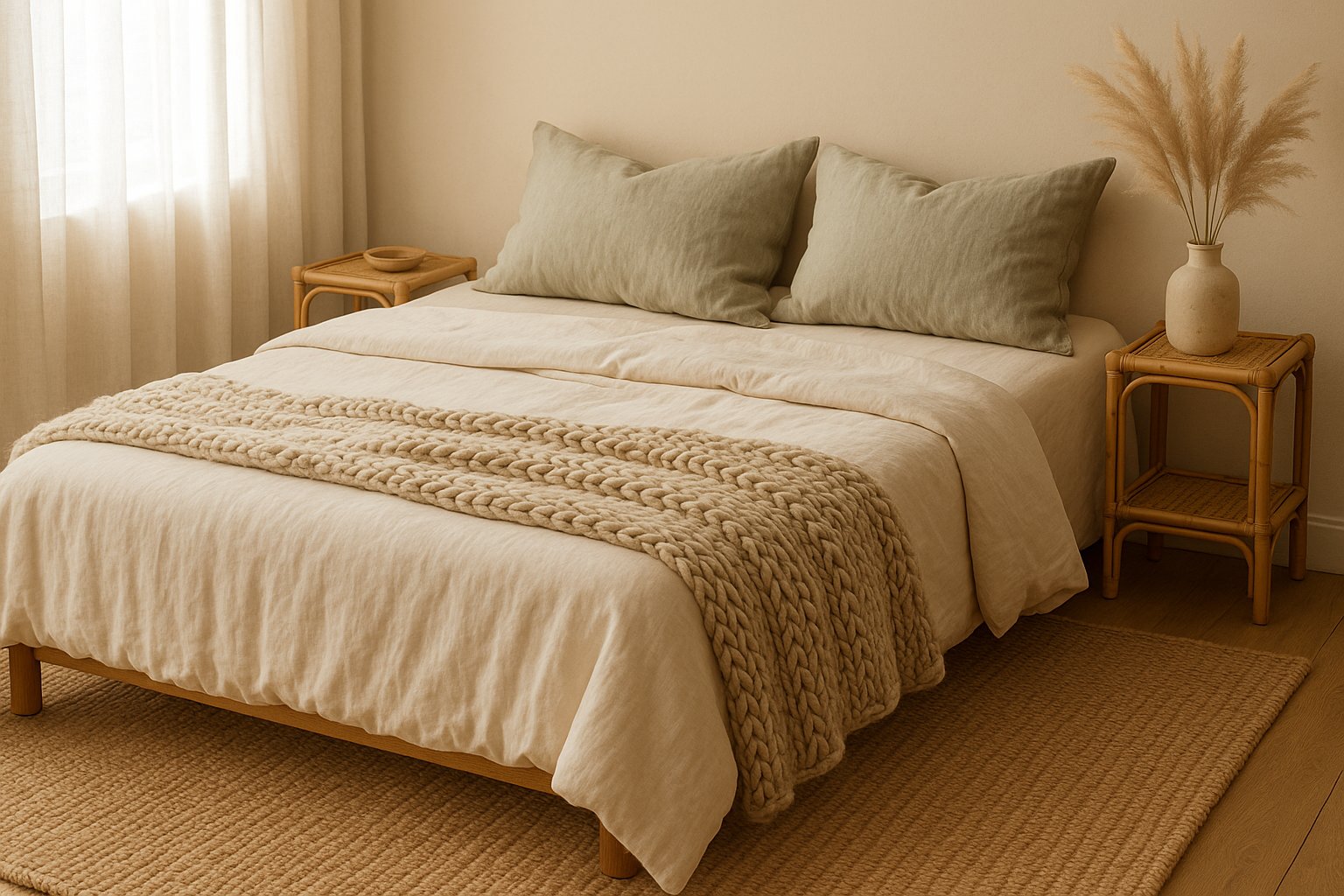
Cozy bedroom with a natural wood bed frame, beige bedding, knit blanket, and green pillows beside a woven rug and nightstand.

Bedding

Shop bedding and pillows chosen for comfortable natural materials and clearly disclosed construction.

How to Choose Non-Toxic Bedding

Most people focus on mattress toxicity and overlook what’s directly against their skin for 8 hours a night. Here’s what to evaluate in your bedding:

Sheets & Pillowcases

The biggest concern in conventional sheets is easy-care chemical finishes — formaldehyde-based treatments that prevent wrinkles and shrinkage but off-gas directly against your skin. Look for GOTS-certified organic cotton or linen, which verifies both the fiber and the processing. "100% cotton" without certification can still be conventionally grown (heavily pesticide-treated) and chemically finished. Thread count is less important than certification — a 300-thread-count GOTS sheet is a meaningfully better choice than a 600-thread-count conventional one.

Pillows

Conventional pillows are almost universally polyester fill or polyurethane foam — both petroleum-derived, and foam pillows may contain chemical flame retardants. Healthier alternatives include certified organic wool, organic latex, buckwheat, and responsibly sourced down. Wool and latex are naturally flame-resistant without chemical treatment. Down is a clean fill but sourcing and processing matter — look for RDS (Responsible Down Standard) or Downmark certification.

Mattress Toppers

Most mattress toppers are polyurethane foam — the same material as conventional mattresses, with the same off-gassing concerns. Organic wool and organic latex toppers are the cleanest alternatives. Wool is naturally temperature-regulating, moisture-wicking, and flame-resistant. Latex toppers should carry GOLS (Global Organic Latex Standard) certification to verify the latex is genuinely organic and processed without harmful chemicals.

Mattress Protectors

Waterproof mattress protectors are a particular concern because the waterproofing layer is often PVC (vinyl) or PFAS-treated fabric — both high-toxicity materials. Look for protectors that use a TPU (thermoplastic polyurethane) waterproof layer instead, which is PVC- and PFAS-free. The fabric layer should ideally be GOTS-certified organic cotton. Avoid any protector that doesn’t disclose its waterproofing material.

How We Vet

We look for bedding made from certified organic cotton (GOTS), organic wool, or organic linen — verified through the full supply chain, not just the outer fabric. We check for OEKO-TEX STANDARD 100 or GOTS certification as meaningful third-party verification of low harmful substance content. We avoid products with formaldehyde-based wrinkle or shrink treatments, synthetic fragrance, optical brighteners, and chemical flame retardant treatments. For fill materials, we prioritize certified organic wool and down with transparent sourcing over polyester and polyurethane alternatives. We evaluate mattress protectors specifically for PVC- and PFAS-free construction.

Bedding and Pillow FAQs

  • Casper mattresses are made primarily from polyurethane foam and are CertiPUR-US certified, which means the foam meets basic emissions limits for VOCs and excludes certain chemicals like PBDE flame retardants and heavy metals. However, CertiPUR-US is not the same as organic or truly non-toxic — it certifies polyurethane foam, which is a petroleum-derived synthetic material, against a relatively limited set of criteria. Casper mattresses are not GOTS or GOLS certified, do not use organic materials, and the full chemical composition of their proprietary foams is not publicly disclosed. For people prioritizing genuinely low-toxicity sleep, a GOTS/GOLS-certified organic mattress using natural latex, organic wool, and organic cotton is a meaningfully cleaner option than any CertiPUR-US foam mattress, including Casper.

  • Tuft & Needle mattresses are made from proprietary adaptive foam and are CertiPUR-US and GREENGUARD Gold certified. GREENGUARD Gold is a more rigorous standard than CertiPUR-US alone — it tests for over 10,000 chemical emissions and sets stricter limits. That said, Tuft & Needle mattresses are still fundamentally synthetic foam products. They do not use organic materials, natural latex, or wool, and are not GOTS or GOLS certified. GREENGUARD Gold certification means emissions are low relative to tested benchmarks, but it does not mean the mattress is free from all synthetic materials or petroleum-derived compounds. For people with chemical sensitivities or those seeking organic certification throughout the supply chain, a certified organic mattress remains the cleaner choice.

  • Purple mattresses use a proprietary hyper-elastic polymer grid made from a food-grade material they call "Hyper-Elastic Polymer," combined with polyurethane foam layers. The mattresses are CertiPUR-US certified. Purple has stated their grid material is made from a non-toxic polymer, but the full formulation is proprietary and not independently verified beyond CertiPUR-US. Like other foam mattresses, Purple is not made from organic materials and does not carry GOTS or GOLS certification. The grid construction is genuinely different from standard foam and may offer lower off-gassing than dense polyurethane layers, but Purple is not in the same category as certified organic mattresses made with natural latex, organic wool, and organic cotton. If avoiding synthetic materials entirely is the priority, a GOTS/GOLS-certified organic mattress is the cleaner option.

  • Nectar mattresses are made from memory foam layers and are CertiPUR-US certified, meaning the foam meets basic emissions standards and excludes certain prohibited chemicals. However, Nectar does not carry GREENGUARD Gold, GOTS, or GOLS certification, and memory foam in particular is a dense polyurethane material that can off-gas VOCs — especially when new. Memory foam also tends to retain heat, which can accelerate off-gassing in a warm bedroom environment. Nectar does not use organic materials or natural latex. For people prioritizing low chemical exposure during sleep, memory foam mattresses generally rank lower than latex or innerspring mattresses with organic material layers, and significantly lower than GOTS/GOLS-certified organic mattresses.

  • The waterproofing layer is the main toxicity concern in mattress protectors. Most conventional protectors use PVC (vinyl) or PFAS-treated fabrics for waterproofing — both high-concern materials. PVC off-gasses plasticizers including phthalates, and PFAS ("forever chemicals") are persistent in the body and environment and have been linked to hormone disruption and immune effects. The cleaner alternative is TPU (thermoplastic polyurethane), which provides effective waterproofing without PVC or PFAS. The fabric layer should ideally be GOTS-certified organic cotton rather than conventionally grown and chemically finished cotton. If a protector doesn’t disclose what its waterproofing material is, treat that as a red flag — clean brands are transparent about this specifically because it’s the question most informed shoppers ask.

  • For eczema and sensitive skin, the most important factors in sheets are fiber, finish, and dye. GOTS-certified organic cotton is the gold standard — it’s grown without synthetic pesticides and processed without formaldehyde-based wrinkle treatments or optical brighteners that can irritate compromised skin barriers. Linen (especially OEKO-TEX certified) is another excellent option — naturally hypoallergenic, moisture-wicking, and gets softer with washing. Avoid microfiber and synthetic blends, which don’t breathe well and can trap heat and moisture against the skin. Stick to undyed or naturally dyed options where possible, and wash new sheets before first use to remove any residual processing chemicals. Fragrance-free, dye-free detergent is equally important — sheets can absorb detergent residue that then contacts skin directly overnight.

  • The safest pillow fill materials are certified organic wool, organic latex (GOLS-certified), buckwheat, and responsibly sourced down (RDS-certified). Organic wool is naturally hypoallergenic, moisture-wicking, and flame-resistant without chemical treatment — and GOTS certification verifies the entire supply chain. Organic latex is supportive, durable, and low off-gassing when GOLS-certified; avoid latex pillows without certification since processing methods vary widely. Buckwheat is a fully natural, biodegradable option with good airflow and adjustability. RDS-certified down is a clean fill from a traceability and animal welfare standpoint. The fills to avoid are polyester fiberfill (petroleum-derived, may contain chemical treatments) and polyurethane foam (off-gasses VOCs, often contains flame retardants). "Memory foam" and "gel" pillows fall into the foam category regardless of marketing language.

  • Down itself is a natural material and not a significant source of chemical exposure — but the processing and the shell fabric matter. Conventional down can be washed with harsh chemicals and anti-microbial treatments, and the outer shell is often made from conventionally grown, chemically finished cotton. For the cleanest option, look for down pillows with RDS (Responsible Down Standard) or Global Traceable Down Standard certification for the fill, and a GOTS-certified organic cotton shell. Also check that no synthetic fragrance or anti-allergen chemical treatments have been applied to the fill — these are common in "hypoallergenic" down products and can be irritating. True hypoallergenic performance in a down pillow comes from thorough washing of the down, not chemical treatment.