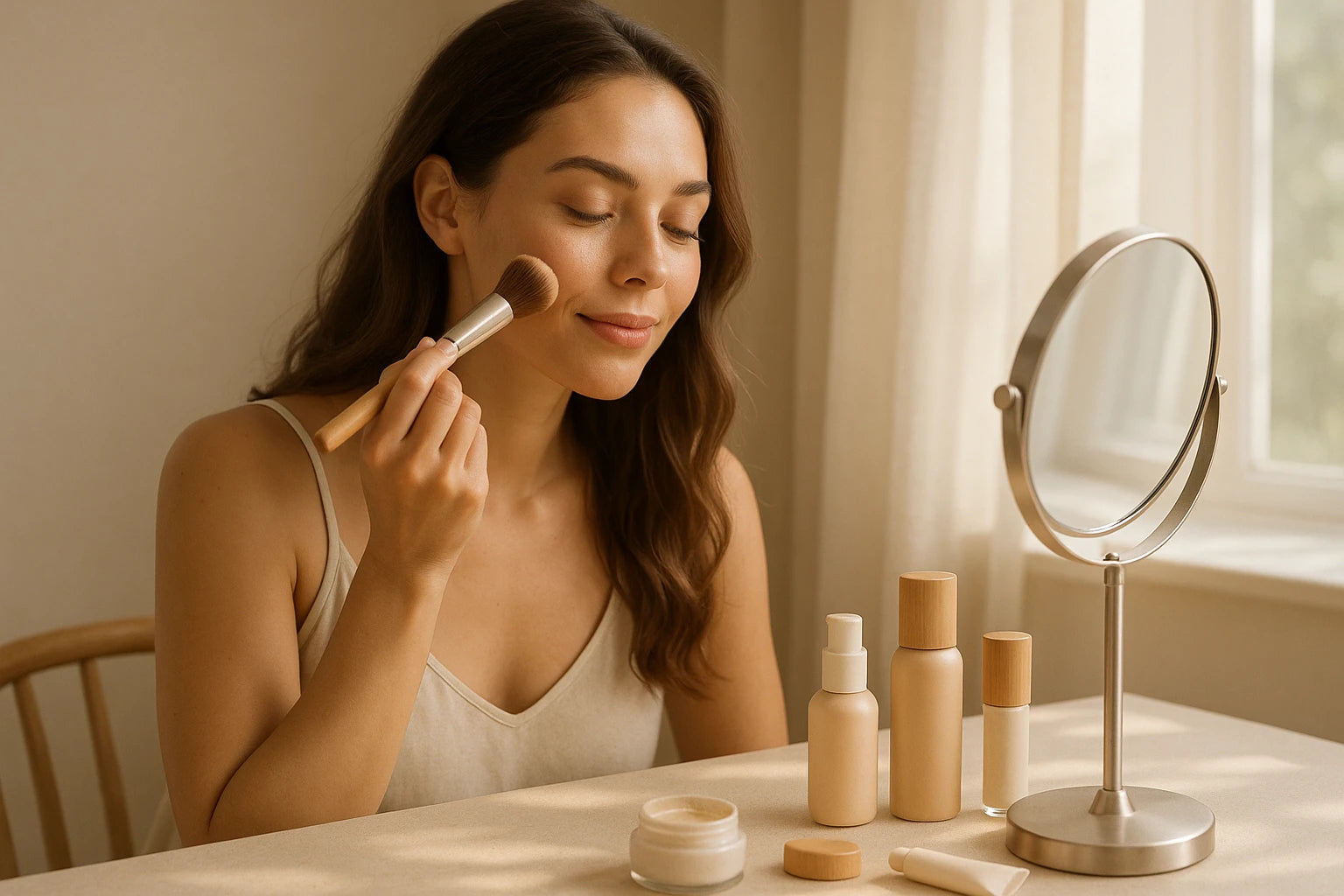
Woman applying makeup with a brush at a vanity, surrounded by natural, eco-friendly cosmetics.

Makeup

The average person applies over 100 unique chemicals to their skin daily through personal care and cosmetics — and makeup is one of the highest-exposure categories, applied close to eyes and mouth, often multiple times a day, for decades. Conventional cosmetics routinely contain parabens, PFAS (“forever chemicals” used in long-wear formulas), synthetic fragrance, heavy metal colorants, and carbon black — none of which are required to be disclosed in fragrance blends. Every product in this collection is formulated without these ingredients and performs well enough that you don’t have to choose between safety and results.

How to Choose Non-Toxic Makeup

The clean beauty market is the most heavily greenwashed category in consumer products. Here’s what the research actually shows about the most common concerns:

PFAS in Makeup: A Serious and Underreported Problem

PFAS (“forever chemicals”) have been found in a wide range of cosmetics in independent testing — including foundation, mascara, lip products, and concealer. They’re used to create smooth application, long wear, and water resistance, and they are not required to be listed on labels. A 2021 study in Environmental Science & Technology Letters found PFAS in 52% of foundations and eye products tested, with some of the highest concentrations in products marketed as “long-lasting” or “waterproof.” PFAS accumulate in the body, disrupt hormones, and are associated with thyroid disease, immune effects, and increased cancer risk. The only way to avoid them is to choose brands that provide independent third-party testing confirming PFAS-free status — not just ingredient label review, since PFAS aren’t always individually listed.

What’s in Conventional Mascara

Mascara is one of the most problematic conventional makeup products because it’s applied directly adjacent to one of the most absorptive mucous membranes in the body — the eye. Common concerning ingredients in conventional mascara include carbon black (a carcinogenic pigment classified as a possible human carcinogen by IARC), parabens as preservatives, synthetic fragrance, PFAS in waterproof formulas, and aluminum powder in some volumizing formulas. The preservative challenge is real: mascara is a high-risk product for bacterial contamination given repeated exposure to the eye area, which is why clean mascara formulas need effective, non-toxic preservatives — phenoxyethanol at low concentrations, vitamin E, and rosemary extract are among the more defensible options. Our safe mascara guide covers the best non-toxic mascaras we’ve tested.

The Fragrance Problem in Cosmetics

Synthetic fragrance is the single most common hidden hazard in conventional cosmetics. A single “fragrance” or “parfum” listing can represent dozens of undisclosed chemicals — including phthalates used as fixatives, benzene derivatives, musks that accumulate in body tissue, and VOCs that contribute to indoor air pollution. Cosmetic fragrance is exempt from full disclosure under U.S. law, making it the easiest way for brands to hide problematic ingredients. “Natural fragrance” is only marginally better — it’s still largely unregulated and can include sensitizing compounds. For people with reactive skin, autoimmune conditions, or hormone concerns, fragrance-free is the safest choice.

Talc and Heavy Metals in Makeup

Talc is a common filler in powder makeup, eyeshadow, and blush — and naturally occurring talc is frequently contaminated with asbestos, a known carcinogen, since the two minerals form in proximity geologically. The FDA has found asbestos in talc-containing cosmetics in multiple rounds of testing, including in children’s products. We require asbestos-free certification for any talc-containing products we carry, and prefer talc-free formulas where equivalent performance is achievable. Heavy metal colorants — lead, arsenic, mercury, cadmium — are found as contaminants in some conventional color cosmetics, particularly lip products and eyeshadow. They’re not intentionally added but present in the raw pigment materials. Third-party testing for heavy metals is an important quality signal for any brand we evaluate.

We screen makeup products for: no PFAS or fluorinated compounds (commonly used in long-wear and waterproof formulas), no parabens, no synthetic fragrance or parfum, no carbon black (a carcinogenic pigment used in mascaras and eyeliners), no formaldehyde-releasing preservatives (DMDM hydantoin, imidazolidinyl urea, quaternium-15), no heavy metal colorants above trace levels, and no talc without asbestos-free certification. We also require full ingredient disclosure — we do not carry products that hide ingredients behind “product blend” or proprietary formula language. Performance is evaluated alongside safety — clean makeup that doesn’t work doesn’t belong in this collection.

Makeup FAQs

  • Yes — independent testing has found PFAS in a wide range of conventional makeup products. A 2021 study in Environmental Science & Technology Letters tested 231 cosmetics and found PFAS in 52% of foundations and eye products, with particularly high concentrations in long-wear and waterproof formulas. PFAS are used in cosmetics to create smooth application, water resistance, and extended wear — and they are not required to be listed on ingredient labels by name, making them essentially invisible to consumers doing label checks. The health concerns are significant: PFAS accumulate in the body over time, disrupt hormone signaling, affect thyroid function and immune response, and are associated with increased risk of several cancers. Given that makeup is applied daily, often close to mucous membranes (eyes, mouth), for decades, PFAS exposure from cosmetics is a meaningful cumulative risk. The only reliable way to avoid PFAS in makeup is to choose brands that provide independent third-party lab testing confirming PFAS-free status — not just clean-sounding ingredient labels.

  • The most important ingredients to avoid in mascara: carbon black (CI 77266) — a pigment classified as a possible human carcinogen by the International Agency for Research on Cancer, used in conventional black mascaras; PFAS or fluorinated compounds — found in waterproof and long-wear formulas, not always listed by name; parabens (methylparaben, propylparaben, butylparaben) — preservatives with endocrine-disrupting activity; synthetic fragrance or parfum — unnecessary near the eye area and a common sensitizer; aluminum powder in volumizing formulas — associated with neurotoxicity at high exposure levels; and formaldehyde-releasing preservatives (DMDM hydantoin, imidazolidinyl urea) — known carcinogens used in some conventional mascaras. A practical note on preservatives: mascara genuinely needs effective preservation due to the high contamination risk from repeated eye contact. Clean mascaras typically use phenoxyethanol (at concentrations under 1%), vitamin E, or plant-derived antimicrobials — these are acceptable trade-offs for a product that needs to stay microbiologically safe for 3 months after opening. Replace mascara every 3 months regardless of formula.

  • For most products and use cases, yes — and the gap has closed significantly in the last five years as clean beauty brands have matured. Foundation coverage, mascara lengthening and volumizing, lip color payoff, and concealer performance are all achievable with clean formulas that perform on par with conventional alternatives. The area where clean makeup still lags is extreme long-wear and waterproofing — the performance characteristics that most often rely on PFAS and silicone-heavy formulations. If you need a mascara that survives a triathlon or a foundation that stays put through an 18-hour day in heat, clean options are improving but not always equivalent. For everyday wear, social events, and most use cases, well-formulated clean makeup performs just as well. The key is choosing brands that actually invest in formulation rather than just removing bad ingredients and hoping the product still works — which is why we only carry makeup that we’ve vetted for both safety and performance.

  • For sensitive skin, the most important foundation criteria are fragrance-free (synthetic fragrance is the leading cause of cosmetic contact dermatitis), no parabens, no alcohol denat as a primary ingredient (drying and irritating), no PFAS, and minimal synthetic preservatives. Mineral-based foundations — using zinc oxide or titanium dioxide as both coverage and sun protection — are often the best-tolerated option for reactive skin because they sit on top of the skin rather than penetrating it, and they have very few ingredients that can cause sensitization. Look for formulas with short, simple ingredient lists — the fewer the ingredients, the lower the likelihood of a reaction. Liquid foundations for sensitive skin should be water-based rather than silicone-heavy, as dimethicone and cyclopentasiloxane can trap debris and worsen breakouts in acne-prone skin. Always patch test a new foundation on the inner wrist or jaw for 24–48 hours before full-face application, regardless of how clean the formula is — individual skin reactions are unpredictable.

  • Cosmetic ingredients in the U.S. are listed in descending order by concentration — the first few ingredients make up the bulk of the formula, while ingredients near the end are present at less than 1% (and can be listed in any order after that threshold). Key things to look for: fragrance or parfum anywhere on the list is a red flag for hidden chemicals; anything ending in -paraben is a paraben preservative; DMDM hydantoin, imidazolidinyl urea, and diazolidinyl urea are formaldehyde-releasing preservatives; ingredients with “fluoro” in the name are likely PFAS; CI 77266 is carbon black. What labels cannot tell you: whether PFAS are present (they’re often unlisted), whether talc is asbestos-free, and whether heavy metal contamination is present in pigments — these require third-party testing data from the brand. A useful tool: the EWG Skin Deep database rates cosmetic ingredients by hazard level and is a good starting point for ingredient research, though it’s not exhaustive. The Think Dirty app is another popular label-scanning option. Neither replaces independent lab testing for contaminants like PFAS and heavy metals.

  • Talc itself is not inherently toxic, but naturally occurring talc is frequently contaminated with asbestos — a known carcinogen — because the two minerals form in proximity geologically and are difficult to fully separate during mining. The FDA has found asbestos in talc-containing cosmetics in multiple rounds of testing, including in children’s products and eyeshadow palettes from major brands. Johnson & Johnson faced decades of litigation over asbestos in its talc-based baby powder before discontinuing the product in North America. For makeup specifically, the concern is highest for loose powders, eyeshadow, blush, and bronzer — products that can become airborne during application and be inhaled. Inhaled asbestos-contaminated talc is a meaningful exposure route given that mesothelioma and lung cancer are associated with asbestos inhalation. The safest approach is to choose talc-free makeup formulas — many clean beauty brands use kaolin clay, mica, rice powder, or arrowroot powder as alternatives. If a product does contain talc, look for brands that provide certificates of analysis showing asbestos testing results below detectable limits from an independent lab.

Popular Blog posts

View all