



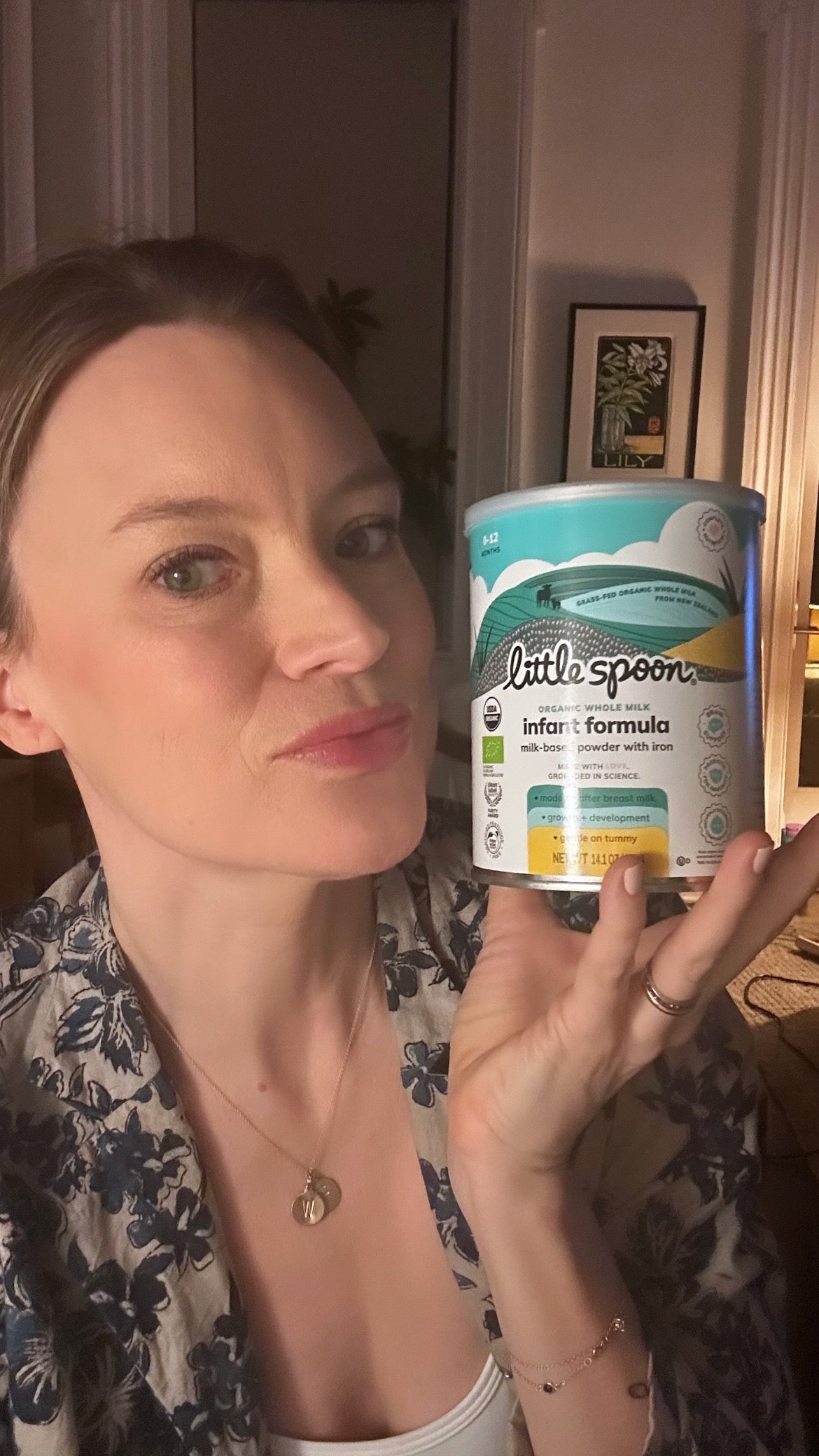
This post is sponsored by Little Spoon. As always, sponsorship does not influence our reviews, and Little Spoon had no input into our opinions or conclusions.
If you've been reading Gimme for a while, you know that baby formula is the product category I obsess over the most. I've spent more than a decade comparing ingredient lists in American and European brands, reviewing manufacturing practices, and interviewing founders of new formulas to try to answer this question: If I am not exclusively breastfeeding, what is the best formula for my baby?
In recent years, we've seen a wave of new premium formula brands enter the market, promising cleaner ingredients, better sourcing, and formulations that more closely resemble breast milk. And unfortunately, two of these, Nara and ByHeart, were recently recalled after outbreaks of infant botulism were linked to their products.
Little Spoon, a baby and kid food brand we’ve been recommending for years, also recently entered the formula space, and quickly earned our Best Stuff designation for their thoughtful formulation. Because so many readers have asked me about it, I wanted to provide an even closer look here.
What Makes a Formula "Good Stuff"?
Before we talk specifically about Little Spoon, it's worth reviewing the criteria we use when evaluating infant formula.
In general, I look for:
-
Whole milk instead of skim, which preserves more naturally occurring milk fat and reduces the need for added vegetable oils.
-
Lactose, which is the primary carbohydrate source in human milk.
-
No corn syrup solids.
-
Whey, which is plentiful in human breast milk.
-
Prebiotics, to mimic the natural properties of breast milk.
-
Nucleotides, which are important for brain development.
-
DHA and ARA, two long-chain fatty acids that are naturally present in breast milk and support brain and eye development.
No formula is identical to breast milk, but the ones that hit these standards come the closest.
What I Like About Little Spoon Formula
Organic Whole Milk
One of the things that immediately stood out to me is that Little Spoon uses organic whole milk as its foundation.
Most formulas use skim milk and then add vegetable oils to supply fat. In Little Spoon’s case, the natural fat profile of the whole milk is preserved rather than reconstructed from oils, which means the omega-6 level sits squarely within the breast milk range — something most premium formulas don’t achieve.
In addition, naturally occurring MFGM (milk fat globule membrane) is present because it is naturally found in the milk fat globule; it doesn’t need to be added separately, because it was never stripped out.
Grass-Fed New Zealand Dairy
Little Spoon sources its whole milk from grass-fed New Zealand cows, which graze on pasture for 350+ days out of the year! (The USDA Organic minimum is 120 days, so this far surpasses that standard.)
While "grass-fed" isn't a guarantee of superior nutrition, I appreciate companies that prioritize pasture-based dairy systems. New Zealand also has a strong reputation for dairy quality and animal welfare. According to the company, New Zealand cows eat up to eight times more grass than cows in the typical U.S. grain-fed, barn-confined dairy industry.
Inclusion of Important Nutrients for the Gut
Little Spoon includes all five of the nucleotides (the building blocks of DNA and RNA) that are found in breast milk. Because cow’s milk contains far lower concentrations, most formula-fed infants don’t get enough without supplementation. Nucleotides are important for things like immune development and gut health.
Little Spoon also includes FOS (fructooligosaccharides), a prebiotic fiber that feeds beneficial gut bacteria. Together with nucleotides—which support beneficial bacterial growth through a separate mechanism—these ingredients take a really smart, multi-pronged approach to supporting the infant gut microbiome.
Exceptional Testing Protocols & Certifications
In addition to hitting all the marks in terms of ingredients, one thing that really stood out to me is Little Spoon’s emphasis on quality control and testing. This feels especially crucial in light of the recent formula recalls.
Little Spoon’s formula is certified USDA Organic, carries the Clean Label Project Purity Award, is Certified Pesticide Free, and meets the First 1,000 Day Promise standards. According to Little Spoon, the formula also meets the terms of the U.S.–EU Organic Equivalence Arrangement.
The company also says that every batch undergoes more than 2,000 individual safety and quality checks before it's released. Little Spoon even screens every batch for sulfite-reducing clostridia, which can serve as an indicator of spore-forming bacteria, including the one that causes botulism. According to the company, this testing is performed using limits that are ten times stricter than current international guidance.
No amount of testing can guarantee that any food product is risk-free, but I do appreciate companies that are transparent about the safeguards they have in place. Rigorous testing and quality control are just as important as a clean ingredient list.
What I Don't Love About Little Spoon
Like every formula sold in the United States, Little Spoon remains a processed food. It still relies on added oils and supplemental nutrients, because that's simply how infant formula works.
So, while there is not another formula on the market that I believe is doing it better than Little Spoon, breastmilk will always be the best for your baby (but you already know this!).
How Does Little Spoon Compare to Other Popular Formulas?
Many parents ask how Little Spoon stacks up against brands like Kendamil, Bobbie, Earth's Best, and Holle.
What impresses me is that Little Spoon successfully combines several features that do not exist in any other single premium formula (grass-fed whole milk, all five nucleotides, prebiotics, omega-6 at breast milk range, etc.) and then on top of that offers the most rigorous testing of any brand we reviewed.
Interestingly, Little Spoon is the only newer, premium formula to contain L–carnitine, which helps infants convert fat into cellular energy. This is a mandatory inclusion in EU infant formula standards, but absent from some U.S. formulas that position themselves as EU-aligned
Little Spoon also has exceptionally high levels of DHA and ARA (20 mg and 34 mg per 100 calories, respectively), both at levels consistent with breast milk averages.
Finally, in light of the recent recalls, we think parents will want to know that Little Spoon is the ONLY premium formula brand to publicly publish batch-level safety test results.
The Bottom Line on Little Spoon Formula
Little Spoon's new formula is arguably the most thoughtfully formulated product we’ve reviewed. I particularly appreciate the organic grass-fed New Zealand whole milk foundation, lactose-first approach, and impressive testing protocols. It’s also manufactured in the U.S. with experts who have over 25 years of formula expertise, which feel reassuring in light of the recent recalls.
If I were formula-feeding a baby today, Little Spoon would absolutely be on my short list.


