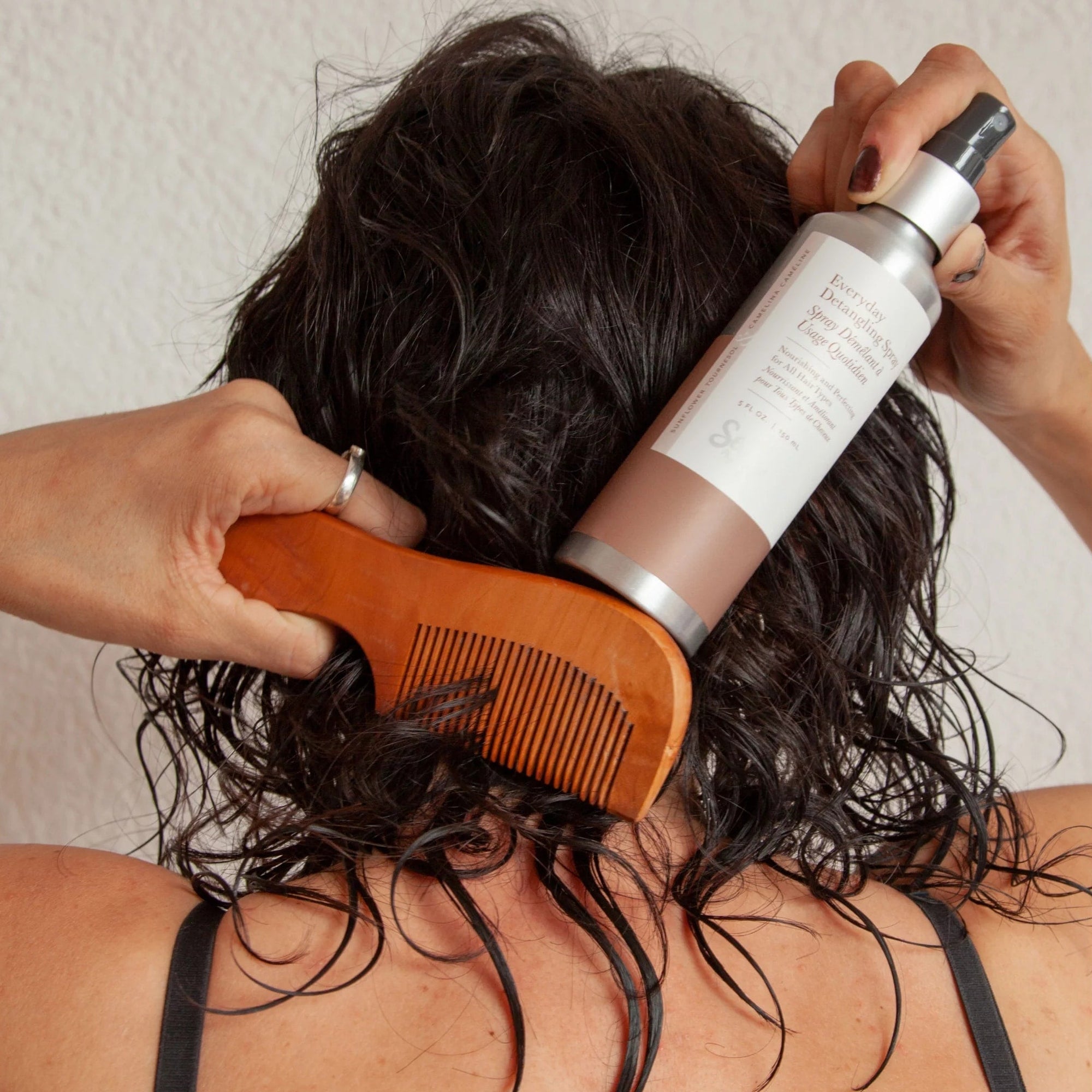
Close-up of a person with curly hair applying a natural hair product using a wooden comb.

Hair Care

Conventional hair care products are among the most chemically complex in your bathroom — synthetic fragrance, sulfates, silicones, parabens, and preservatives applied directly to your scalp daily. Everything here is curated for clean, effective formulations that work for every hair type without the chemical load.

How to Switch to Non-Toxic Hair Care

1. The Biggest Concerns in Conventional Shampoo

Synthetic fragrance is the top concern — it sits on your scalp, the most absorbent skin on your body, and contains phthalates and other undisclosed chemicals. Sodium lauryl sulfate (SLS) is a harsh surfactant that strips the scalp’s natural oils and can cause irritation; sodium laureth sulfate (SLES) is milder but often contaminated with 1,4-dioxane, a likely carcinogen. Parabens and phenoxyethanol are preservatives with hormone-disrupting concerns. Silicones build up on the hair shaft and block moisture over time.

2. What to Expect When You Switch

Most people experience a 2–4 week transition period when switching to sulfate-free, silicone-free shampoo. Hair may feel different — sometimes heavier or less “clean” — as the scalp recalibrates oil production and silicone buildup clears. One or two clarifying washes at the start can speed this up. After the transition, most people find their scalp is less dry, hair is less dependent on daily washing, and overall hair health improves.

3. Matching Products to Your Hair Type

Not all clean shampoos work equally for all hair types. Fine hair needs lighter conditioning agents and lower protein content. Curly and coily hair needs more moisture and slip. Color-treated hair benefits from sulfate-free formulas that don’t strip color. Fragrance-sensitive people should look for explicitly fragrance-free options rather than “unscented,” which can still contain masking fragrances.

Read our full Non-Toxic Shampoo Guide for brand-by-brand breakdowns and ingredient deep-dives.

We avoid synthetic fragrance, sulfates (SLS/SLES), parabens, silicones, phthalates, phenoxyethanol (a preservative with endocrine concerns), formaldehyde-releasing preservatives like DMDM hydantoin, PEGs, and sodium benzoate in acidic formulations (where it can convert to benzene). We look for fully disclosed ingredient lists, plant-derived cleansers and conditioning agents, and products that perform without relying on synthetic film-formers or coating agents.

Hair Care FAQs

  • The main ingredients to avoid in shampoo: synthetic fragrance (listed as “fragrance” or “perfume”), sodium lauryl sulfate (SLS) and sodium laureth sulfate (SLES), parabens (methylparaben, propylparaben, butylparaben), silicones (dimethicone, cyclomethicone, any ingredient ending in -cone or -siloxane), phenoxyethanol (a preservative with endocrine concerns), formaldehyde-releasing preservatives like DMDM hydantoin and quaternium-15, sodium benzoate (problematic in acidic formulations where it can form benzene), PEGs, and artificial dyes. For the cleanest shampoos, look for short ingredient lists with recognizable plant-derived cleansers like sodium cocoyl isethionate or decyl glucoside.

  • For most people, yes. Sodium lauryl sulfate (SLS) is an effective but harsh detergent that strips the scalp’s natural oils, disrupts the skin barrier, and can cause scalp irritation, dryness, and sensitivity with regular use. Sodium laureth sulfate (SLES) is milder but is often contaminated with 1,4-dioxane, a likely carcinogen, as a byproduct of the ethoxylation process. Sulfate-free shampoos use gentler plant-derived surfactants that cleanse without over-stripping. They’re especially beneficial for color-treated hair (sulfates accelerate color fading), curly hair (which tends toward dryness), and anyone with a sensitive or reactive scalp.

  • Phenoxyethanol is a synthetic preservative widely used in “paraben-free” personal care products as a paraben alternative. It’s considered safer than parabens by many standards, but it’s not without concerns — the FDA has warned that it can cause reactions in nursing infants when used in nipple creams, and the EU has restrictions on its concentration. Some research suggests it has mild endocrine-disrupting properties. More practically, it’s a known skin sensitizer at higher concentrations. In shampoo, it sits on your scalp during every wash. It’s not the highest-priority ingredient to avoid, but for the cleanest formulas, there are better preservation systems using natural antimicrobials like rosemary extract, vitamin E, and fermentation-derived preservatives.

  • The brands most worth avoiding are those that use synthetic fragrance, silicones, sulfates, and parabens as core formulation ingredients — which includes most drugstore brands like Pantene, Head & Shoulders, Herbal Essences, TRESemmé, and Suave. Many “natural” brands also fall short: some use synthetic fragrance despite a green image, others use phenoxyethanol or sodium benzoate without full transparency. The key is to evaluate products by their ingredient list, not their branding. ⚠️ Please verify specific brand recommendations and our current “best and worst” list against our Non-Toxic Shampoo Guide, which we update regularly.

  • Technically, nothing is truly chemical-free — water is a chemical, and so is every ingredient in any shampoo. When people search for “chemical-free shampoo,” they generally mean shampoos free from synthetic, petroleum-derived, or harmful chemicals — specifically things like synthetic fragrance, sulfates, parabens, silicones, and preservatives with health concerns. It’s a marketing term that’s often misused, which is why we focus on specific ingredients to avoid rather than vague claims. A shampoo with a fully disclosed, plant-based ingredient list and no synthetic fragrance or harmful preservatives is what most people are actually looking for when they search “chemical-free.”

  • Native markets itself as a clean personal care brand, but their shampoo formulations contain synthetic fragrance — which is a significant concern for scalp health and hormone disruption. Their products are free from sulfates and parabens, which is a step in the right direction, but the presence of undisclosed synthetic fragrance means they don’t meet our standard for truly non-toxic. There are cleaner alternatives with fully disclosed, fragrance-free or naturally-scented formulas. ⚠️ Please verify this assessment against our Non-Toxic Shampoo Guide for the most current evaluation.

Popular Blog posts

View all