


Read on for more about the best non-toxic laundry detergents we love, what to look out for when choosing a detergent, and the 17 “natural” laundry detergent brands we’d advise you to avoid.
The Ultimate Non Toxic Laundry Detergent Guide (2025 Edition)


In This Guide

1

2

3

4

5

6

7

8

9

10

1. Mama Suds
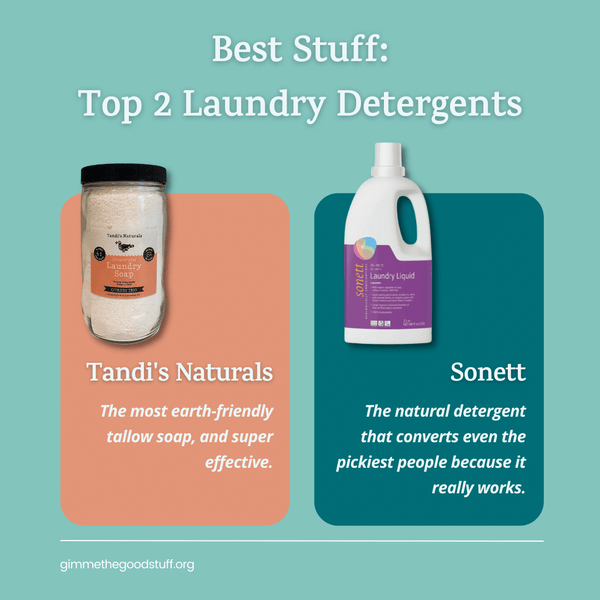
3. Tandi's
4. Sonett
5. Meliora
8. Molly Suds Laundry Detergent
9. Aspen Clean Laundry Detergent
10. Rebel Green






378 comments
Amanda
Then I’d like to know which detergent you suggest JP…
Tammie Clippert
What about fading? Which soaps are gentle on clothes.? My baby’s 22. I’m no longer washing diapers. I want my work clothes to look bright – not faded. Thanks
JP
I agree with Vic’s comments. I have just stumbled across this site and as a chemist I find the degree of misinformation on here appalling.
I worked in the pharmaceutical industry for years QC testing most of the raw materials in these products. Even the so called “good stuff” contains small amounts of heavy metals(arsenic, lead) residual solvents and potential allergens in essential oil components.
The limits set for these impurities and residues are very strict and are such small amounts. (usually less than a few parts per million) there is very little cause for concern.
This is what happens when you have people with no understanding of toxicology or chemistry blogging whatever they have read on some other fools website.
Blind leading the blind
Vic
My problem with “healthy and natural livingâ€, in principle a good thing, is that it is often, if not always, synonymous of bad science. For example, it is a disservice to give people the impression that natural means safe, and synthetic means potentially toxic. There are too many statements in your blog as to “natural and safeâ€. If you really want to contribute to consumer education, you should dispel this wrong idea. In fact, often natural is more dangerous than synthetic, because natural products are not always tested toxicologically, whereas synthetic ones do, and the bad ones are weeded out or controlled. For example, your favorite detergent contains litsea cubeba, which has oils rich in citral; you know this is a chemical, a strong allergen, and 100% natural, as you say in another section of your blog. There is also misleading information on dioxane, which is contained in Tide at levels that are absolutely no concern. The dose makes the poison. Carcinogen is a misleading word: at what level? Do the math and figure out how silly this concern is. You state that residual detergents can be absorbed through the skin. Can you support these statements with data? Ionic detergents are not absorbed. It takes a lot of mental gymnastics to label decyl glucoside, the typical non-ionic detergent contained in many of these products, “naturalâ€: it is made of two components joined together by a chemical reaction, and therefore it is not natural. We live in a chemical world. As a chemist, I know some chemicals, synthetic or natural, are bad for you, and some are good, and good can be bad at a higher dose. Unfortunately, the most toxic chemicals on the planet are all natural, and I am sure you know why. Amazing that the majority of the people do not understand this simple fact, and waste their money on products containing “rhythmatised waterâ€!
Meghan
I just recently bought My Green Fills because I love the concept of no more plastic jugs. However, it is SUPER fragrant both in the bottle (I can smell it the minute I enter the basement) and on the clothes. The ingredient list looks pure and I can totally just go for the unscented packet next time but it makes me worried that something is in there that shouldn’t be. Is it possible that their essential oils are synthetic and/or that there are unlisted ingredients, or did they confirm the purity of their oils/do they have to list all ingredients? Thanks so much!